Private Walking Tour · History · Freemasonry

Rome Masonic Private Tour

Freemasonry, the Risorgimento and the History of Ideas Through the Streets of Rome
Request a Proposal
Photography by Claudio Colis

Rome's streets preserve the traces of a long struggle between religious authority, political transformation, intellectual freedom and the creation of modern Italy.

This private walking tour explores the history of Freemasonry in Rome through monuments, squares and documented historical locations across the historic centre.

Beginning in Piazza Farnese and continuing through Campo de' Fiori, Piazza Navona, the Pantheon, Piazza della Minerva, Largo Argentina and Piazza del Gesù, the route connects Freemasonry with the Risorgimento, the Catholic Church, classical heritage and the intellectual currents that shaped modern Rome.

Rather than presenting myths or conspiracy theories as history, the experience focuses on documented events while examining how symbols, monuments and historical figures acquired new meanings over time.

An outdoor historical walking tour

This experience takes place through the streets and public spaces of Rome's historic centre. It does not include entry into a Masonic lodge or temple. The itinerary uses documented locations and monuments to reconstruct the history of Freemasonry and its relationship with modern Rome.

Historical Context

Freemasonry and the Making of Modern Rome

The history of Freemasonry in Italy intersects with some of the most important political and intellectual transformations of the eighteenth and nineteenth centuries.

The Risorgimento, the end of Papal temporal rule and the establishment of Rome as capital of the Kingdom of Italy transformed not only the city's government, but also its monuments, public spaces and political symbolism.

Freemasonry formed part of this complex environment, alongside liberalism, nationalism, anticlerical movements, religious institutions and competing ideas about the future of the new Italian state.

The Route

A journey through the ideas that transformed Rome.

The itinerary moves through the historic centre, using the city itself as the primary historical document.

01 Starting Point

Piazza Farnese

The experience begins in one of Rome's most elegant Renaissance squares.

Here, the guide introduces the political and religious environment of Rome before the Risorgimento and the broader European context in which modern Freemasonry developed.

The contrast between Renaissance papal Rome and the political movements that would later challenge the temporal authority of the Church provides the historical foundation for the entire walk.
02 Free Thought

Campo de' Fiori

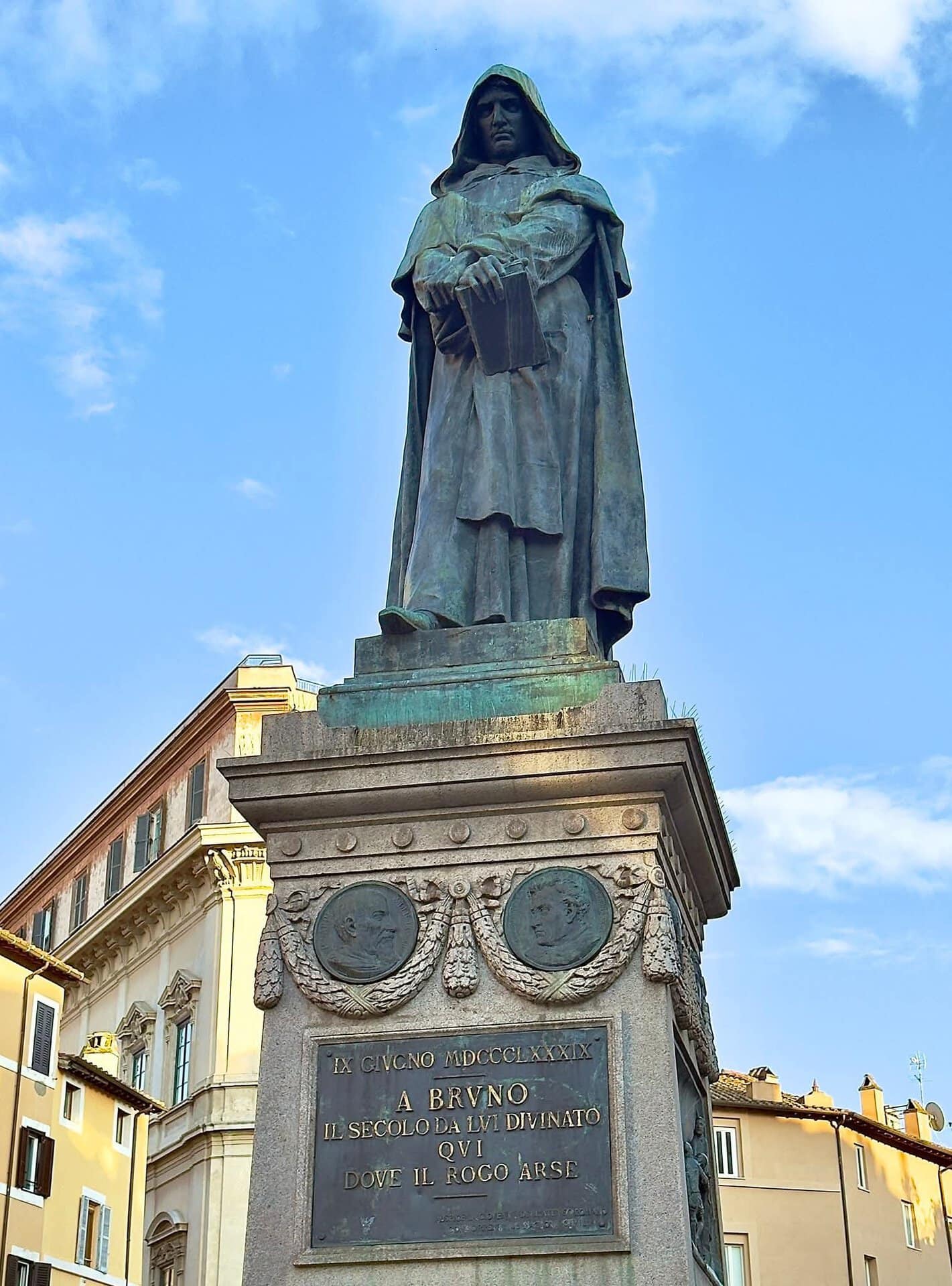
Campo de' Fiori provides one of the most powerful examples of how the meaning of a Roman monument can change according to the political culture surrounding it.

Giordano Bruno was executed here in 1600 by order of the Roman Inquisition. Almost three centuries later, his monument was erected in the square in 1889, after Rome had become capital of the Kingdom of Italy.

Bruno consequently became much more than a historical philosopher. His image was transformed into a powerful modern symbol of free thought, anticlericalism and resistance to religious authority.

Giordano Bruno monument in Campo de' Fiori, Rome
Photography by Claudio Colis
03 Knowledge & Symbolism

Piazza Navona

Piazza Navona opens a broader discussion about Baroque Rome, papal patronage and the intellectual culture of seventeenth-century Europe.

Bernini's Fountain of the Four Rivers and its Egyptian obelisk provide an opportunity to explore Rome's fascination with ancient Egypt, while figures such as Athanasius Kircher reveal how Egyptian writing, cosmology and ancient wisdom were interpreted in early modern Europe.

These traditions later influenced numerous intellectual and symbolic movements, but the tour carefully distinguishes historical connections from later interpretations.

04 Classical Heritage

The Pantheon

Few buildings have influenced Western architecture as profoundly as the Pantheon.

Its geometry, extraordinary dome and relationship with light have fascinated architects, scholars and philosophers for centuries.

During the walk, the monument becomes a starting point for examining the continued influence of classical architecture and geometry on later European intellectual traditions, while separating the Pantheon's documented Roman history from symbolic interpretations that developed centuries afterwards.

Piazza Navona in Rome
Photography by Claudio Colis
05 Egypt & Rome

Piazza della Minerva

Behind the Pantheon stands one of Rome's most intriguing combinations of ancient and Baroque symbolism.

Bernini's elephant carries an ancient Egyptian obelisk discovered nearby, creating an extraordinary encounter between Egyptian antiquity, Christian Rome and seventeenth-century intellectual culture.

The stop provides an opportunity to discuss the fascination with Egyptian knowledge that spread across early modern Europe and later entered many symbolic and esoteric traditions.

06 Italian Freemasonry

Largo Argentina

The area around Largo Argentina brings the discussion directly into the history of organised Italian Freemasonry.

Here the guide introduces the Gran Loggia d'Italia degli A.L.A.M. and the broader development of Masonic institutions in modern Italy.

The discussion examines Freemasonry's changing relationship with politics, civil society and the Italian state without implying that the outdoor itinerary includes access to a Masonic temple or private lodge.

07 Final Stop

Piazza del Gesù

The walk concludes in a location that provides a striking setting for examining competing ideas of authority, religion and society.

The Church of the Gesù, mother church of the Society of Jesus, represents one of the most influential institutions of the Catholic Counter-Reformation.

Against this historical backdrop, the final discussion considers the often difficult relationship between Freemasonry and the Catholic Church and the role that this conflict played in the political and cultural history of modern Italy.

Piazza della Minerva and Bernini's elephant in Rome
Photography by Claudio Colis
History Before Myth

Symbols without conspiracy theories.

Freemasonry has generated an extraordinary number of legends, theories and imagined connections.

This experience takes a different approach.

Where historical connections are documented, they are explored. Where symbols have acquired later interpretations, that distinction is explained. And where popular stories go beyond the surviving evidence, they are presented as interpretations rather than historical fact.

The result is a more interesting story: not a catalogue of supposed secret signs, but an exploration of how ideas, symbols and political movements actually interacted with Rome over time.

Historic Rome along the Rome Masonic Private Tour
Photography by Claudio Colis
Specialist-Led Format

International Guests & Interpreter Service

The specialist leading this itinerary conducts the historical presentation in Italian.

For international guests, a professional interpreter can be arranged upon request, allowing English-speaking visitors to engage fully with the historical discussion, specialist terminology and questions that emerge during the walk.

This format combines specialist subject knowledge with a private experience accessible to international travellers, cultural groups and guests with a particular interest in Freemasonry and modern Italian history.

What You'll Discover

A different intellectual history of Rome.

  • The history of Freemasonry in Rome
  • The Risorgimento and Italian unification
  • Giordano Bruno and the politics of historical memory
  • Freemasonry and the Catholic Church
  • Italian Masonic institutions
  • Ancient Egypt in Rome's symbolic landscape
  • Classical architecture and later symbolic interpretations
  • The Jesuits and the Counter-Reformation
  • Intellectual freedom and political transformation
  • The difference between documented history and modern myth
Tour Details

Practical Information

Format Private outdoor walking tour
Guide Specialist guide
Language Italian specialist presentation; professional interpreter available upon request
Duration Approximately 2.5–3 hours
Route Piazza Farnese to Piazza del Gesù
Access Outdoor itinerary; no Masonic lodge or temple entry included
Area Historic centre of Rome
Best For History, architecture, political thought and symbolism enthusiasts
Rome Beyond the Visible

Walk through the ideas that transformed the Eternal City.

Rome's monuments do not tell only the history of emperors, popes and artists. They also preserve the traces of political movements, intellectual conflicts and competing ideas about religion, freedom and society.

This private walking experience reveals those connections through the streets and squares where Rome's transformation into a modern capital can still be read today.

Request a Proposal