
House of Livia
On the Palatine Hill, beside the residence of Augustus, survives a richly decorated Roman domus traditionally associated with Livia Drusilla.
The attribution is supported by the name Iulia Augusta engraved on a lead pipe found within the building.
Yet the real revelation of the House of Livia lies on its walls.
Mythological scenes, architectural illusions, Egyptian imagery and vivid Roman colour survive in a sequence of rooms dating to around 30 BC.
Few places provide a more intimate encounter with the visual culture of Augustan Rome.
Who Was Livia?
Livia Drusilla was the wife of Augustus and one of the central figures of Rome’s first imperial family.
Born into an aristocratic Roman family, she married Octavian — the future Augustus — in 38 BC.
Their marriage lasted for more than five decades and placed Livia at the heart of the new political order emerging from the collapse of the Roman Republic.
Ancient sources portray her in sharply different ways.
Some emphasise dignity, discipline and traditional Roman virtues. Others, written within hostile political traditions, portray her as an ambitious and manipulative figure.
Modern historical interpretation requires considerably more caution.
How Could a Roman Woman Exercise Influence?
Livia did not hold political office in the way Roman men did.
Yet proximity to Augustus, family networks, patronage and dynastic importance gave her an exceptional position within Roman society.
Her life reveals an important distinction between formal political authority and influence within the imperial household.
Why Is It Called the House of Livia?
The building was brought to light during nineteenth-century excavations on the Palatine Hill.
Its association with Livia is supported by a lead water pipe bearing the name Iulia Augusta.
Livia received the name Julia Augusta after Augustus’ death.
On this basis, the building has traditionally been interpreted as the residence reserved for Augustus’ wife within the wider Augustan complex.
As with many ancient residences, the surviving archaeology does not allow every phase of ownership and use to be reconstructed with absolute certainty.
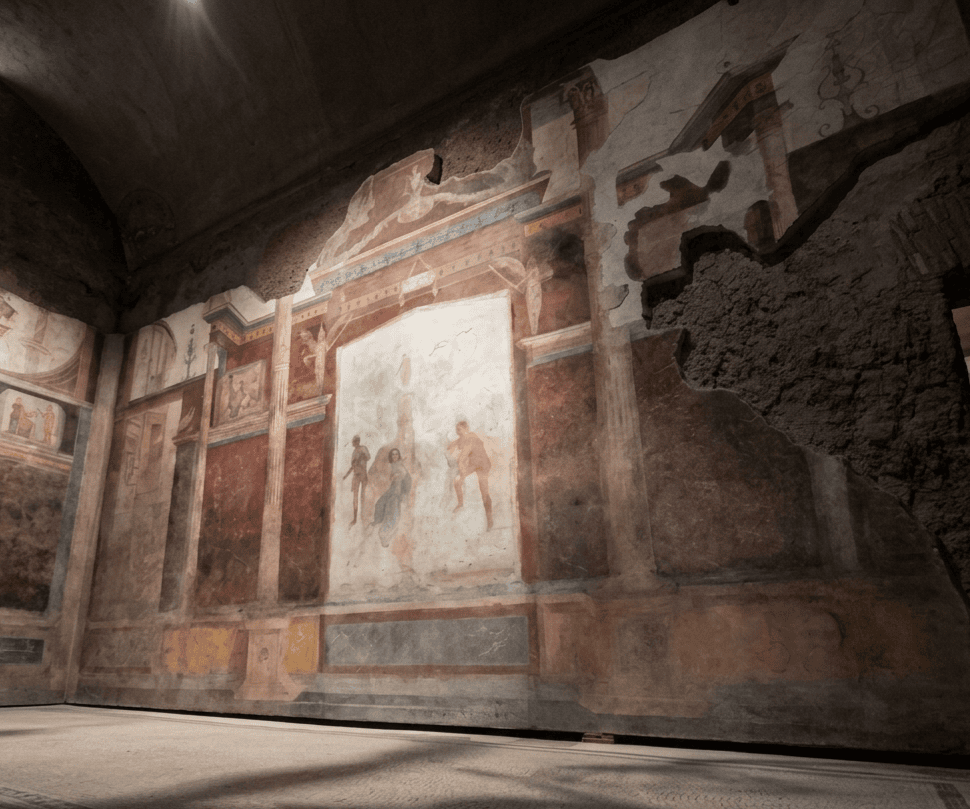
A Roman House Built Around an Atrium
The residence is organised around a quadrangular atrium.
Several rooms open directly onto this central space, preserving mosaic floors and painted walls of exceptional quality.
At the rear stands the tablinum, traditionally the principal reception space of a Roman domus.
On either side are two symmetrical rooms, while the triclinium — or dining room — lies to the right of the atrium.
The scale is domestic, but the decorative programme is anything but ordinary.
Some of the Finest Surviving Second-Style Frescoes in Rome
The painted decoration dates to approximately 30 BC and belongs to the mature phase of what archaeologists call the Roman Second Style.
The walls appear to dissolve through painted architecture, columns, landscapes and carefully constructed illusions of depth.
The result transforms enclosed rooms into imaginary architectural and mythological worlds.
Mythology on the Walls
The tablinum is also known as the Hall of Polyphemus.
On its rear wall, the Cyclops Polyphemus pursues the nymph Galatea.
Another scene depicts Io confronting Argos, the hundred-eyed guardian, while Mercury approaches to free her.
These images were not isolated decoration.
Myth, architecture and visual illusion formed part of a carefully designed pictorial programme within the house.
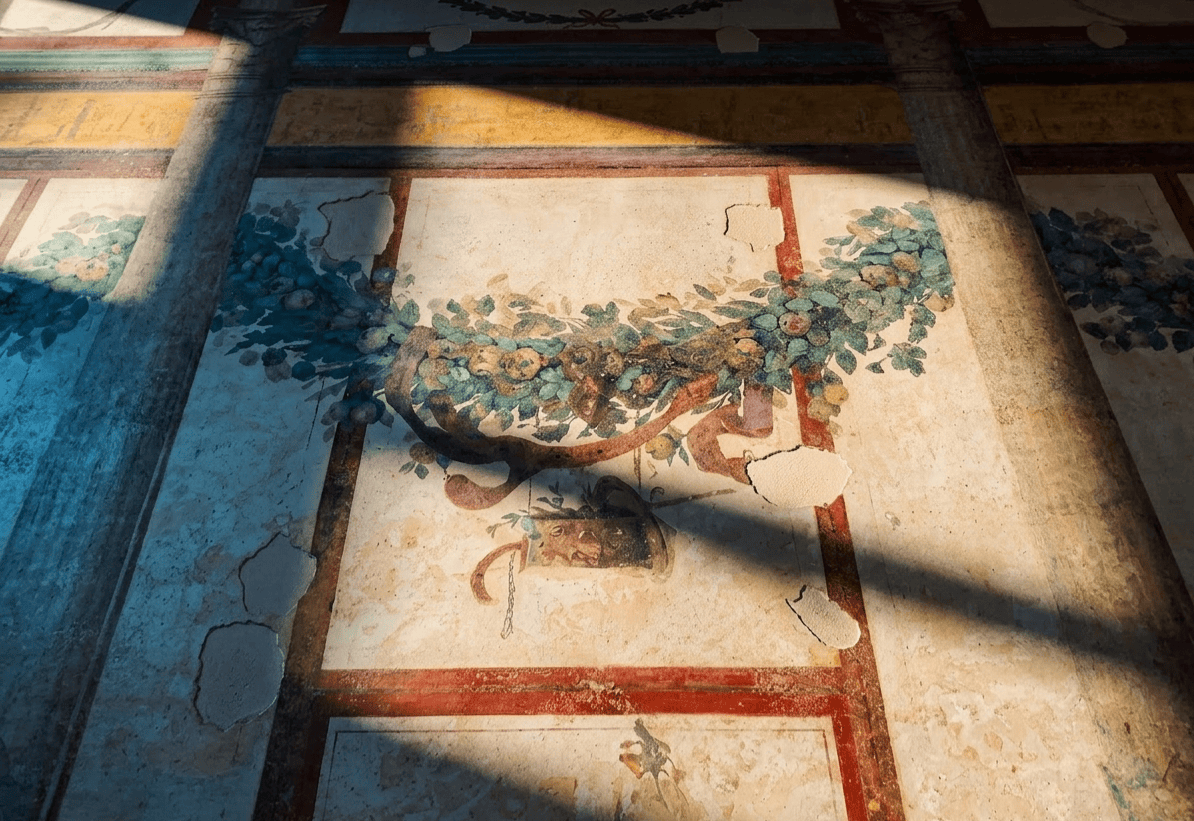
An Unexpected Egyptian Landscape
One of the most intriguing decorative elements appears in one of the side rooms.
Above the painted architecture runs a rare monochrome landscape frieze set against a yellow background.
The scenes include aspects of daily life and ritual activity within an Egyptian setting.
The decoration belongs to the same historical period in which Augustus was transforming Egypt from the kingdom of Cleopatra into a Roman province.
It therefore offers a fascinating visual reminder of how Egyptian imagery entered the artistic language of Augustan Rome.
Pompeian Red and Imagined Landscapes
The triclinium, or dining room, preserves another exceptional decorative scheme.
Against an intense cinnabar-red background, painted architectural structures open onto sacred and rural landscapes.
The illusionistic composition expands the apparent dimensions of the room and demonstrates the sophistication of Roman domestic painting.
For modern visitors, it is one of the clearest reminders that elite Roman houses were carefully designed visual environments, not simply functional residences.
The Famous Garden Room Is Somewhere Else
Images of Livia are frequently associated with one of the most famous surviving Roman fresco cycles: a painted garden filled with trees, flowers and birds.
That extraordinary room, however, does not come from the House of Livia on the Palatine.
It belonged to the Villa of Livia at Prima Porta, a separate suburban residence north of ancient Rome.
The Palatine house possesses its own completely different and equally remarkable decorative programme.
The First Imperial Household
The House of Livia lies within the wider residential complex associated with Augustus on the Palatine.
Together, the House of Augustus and the House of Livia offer an unusually intimate perspective on the environment surrounding Rome’s first imperial household.
They predate the gigantic palace complexes constructed by later emperors.
This difference is crucial.
The earliest imperial residence developed within an existing aristocratic residential landscape before the Palatine became synonymous with monumental imperial palaces.
Discover the adjoining story in House of Augustus .
From Livia to Tiberius
Livia's historical importance extended far beyond her marriage to Augustus.
Her son Tiberius, born from her earlier marriage to Tiberius Claudius Nero, eventually succeeded Augustus as emperor.
Through marriage, adoption and dynastic strategy, Livia occupied a central position in the emergence of what historians call the Julio-Claudian dynasty.
After Augustus’ death, she was adopted into the Julian family and received the name Julia Augusta.
Her memory therefore became inseparable from the political identity of the first imperial house.
Ancient Rome at the Scale of a Room
Much of Ancient Rome impresses through scale.
The House of Livia works differently.
Its historical significance is concentrated in painted rooms, mosaics, architectural details and the intimate arrangement of a Roman residence.
The result is one of the most direct ways to encounter the domestic culture of the Augustan period.
For visitors interested in Roman painting, archaeology, women in antiquity or the origins of imperial Rome, it is an exceptional site.
What You’ll Discover
- Livia Drusilla and the first imperial family
- The evidence behind the attribution of the house
- The inscription Iulia Augusta
- A Roman domus organised around an atrium
- Exceptional Second-Style wall paintings
- The Hall of Polyphemus
- Polyphemus and Galatea
- Io, Argos and Mercury
- Egyptian imagery within Augustan decoration
- The cinnabar-red triclinium
- The relationship with the House of Augustus
- The emergence of the Julio-Claudian dynasty
House of Livia Private Experience
Opening arrangements can vary according to conservation requirements and the regulations of the archaeological park. We design the private itinerary around access available on your date.
Step inside the painted world of Rome’s first imperial family.
The House of Livia offers a rare encounter with Roman history through colour, mythology and domestic architecture.
Combined with the House of Augustus, the Palatine Hill and the Roman Forum, it reveals a more intimate side of the political transformation that created Imperial Rome.
Request a Proposal