Unveiled in Piazza San Silvestro in 1886, moved away in 1910 and returned in 2026: one Roman monument has quietly recorded more than a century of changes in the city around it.
Rome has monuments that have survived wars, demolitions and changes of government. This one also survived the changing demands of the city itself.
On 21 April 1886, a monument to the Roman poet Pietro Trapassi, better known as Metastasio, was inaugurated in Piazza San Silvestro.
In 1910 the statue was transferred to Piazza della Chiesa Nuova to improve traffic circulation. Then, in 2026, preparations connected with the future Metro C station at Chiesa Nuova required the monument to move again.
The destination chosen was where the story had begun: Piazza San Silvestro.
Metastasio was the literary name of Pietro Trapassi, the Roman poet and librettist whose work became central to eighteenth-century European opera seria.
The monument was designed by sculptor Emilio Gallori between 1884 and 1886. Contemporary reporting described it as the first civil monument erected in Rome after 1870 with the participation of the municipality and private subscriptions.
It was inaugurated on 21 April 1886, the traditional anniversary of Rome's foundation. Contemporary accounts record persistent rain and an intriguing detail: while the statue was generally praised, the choice of its location was already criticised.
That criticism would prove unexpectedly prophetic.
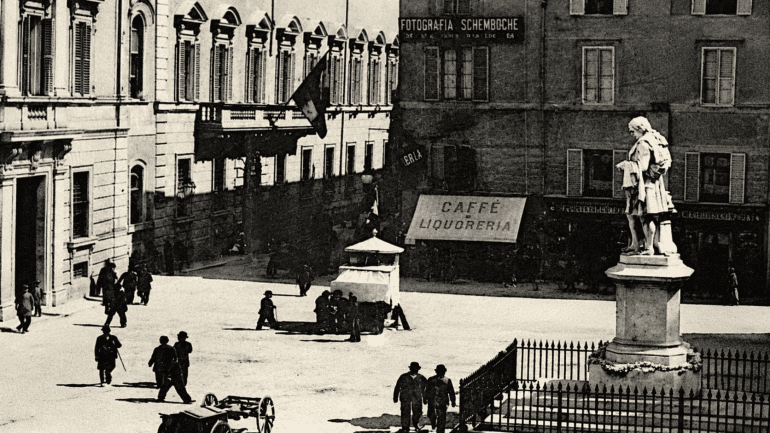
Historic imagery preserves the monument as part of Piazza San Silvestro's urban landscape before its removal.
The image matters because the 2026 return does not invent a new setting. It restores a relationship between monument and square that had disappeared for more than a century.
Historic view of Piazza San Silvestro with the Metastasio monument in its original setting. The precise date of this image is not asserted here.
Unveiled on 21 April, Rome's traditional birthday, in the rapidly changing capital of the new Kingdom of Italy.
The statue was removed from San Silvestro as part of efforts to improve traffic circulation.
Preparations for the T2 section of Metro C and the future Chiesa Nuova station required monuments in the square to be relocated.
Piazza San Silvestro was selected for the statue, returning it to the setting where it had first been unveiled.
The answer is less romantic than the monument itself: traffic.
By the beginning of the twentieth century, Piazza San Silvestro was part of a rapidly changing capital. Public transport and urban circulation were transforming the centre. In 1910 the monument was moved to Piazza della Chiesa Nuova to improve traffic conditions.
The episode captures a larger tension: Rome was celebrating its past while simultaneously adapting itself to the needs of a modern capital.
The second move is also connected to transportation — but this time underground.
Work on the T2 section of Rome's Metro C includes the future Chiesa Nuova station. Preparing the construction area required monuments in Piazza della Chiesa Nuova to be relocated.
The result creates a remarkable symmetry: surface traffic helped remove Metastasio in 1910, while twenty-first-century underground infrastructure brought the monument back in 2026.
Public monuments helped construct the cultural identity of post-unification Rome.
Traffic and public transport increasingly competed with monuments for space.
New infrastructure beneath historic Rome once again changes what appears at street level.
Rome is often presented as a collection of monuments that have occupied the same places forever. The reality is much more dynamic.
Statues move. Fountains are relocated. Streets change level. Buildings disappear. Archaeological remains emerge and are covered again.
The return of Metastasio makes that process visible. A monument that appears perfectly at home in Piazza San Silvestro in 2026 carries the memory of another square, another transport system and another idea of how Rome should work.
We research the transformations and lesser-known histories that explain why the city looks the way it does today.
Explore RPE Research