From Rome to Londinium, surviving Mithraea reveal a hidden religious world of initiation, ritual, celestial symbolism and one of antiquity's most enigmatic images: Mithras killing the bull.
There are ancient religions that we know through texts. Mithraism survives largely through something more fragmentary: temples, sculpture, inscriptions, ritual objects and recurring images.
No complete Mithraic sacred text has survived to explain what initiates believed, what happened during their ceremonies or exactly how they understood the extraordinary symbols surrounding them.
Instead, the cult has left us places: long rooms with benches facing one another, altars, images of the Sun and Moon, zodiacal signs, lions, ravens, snakes and scorpions — and, again and again, Mithras killing the bull.
Rome is one of the greatest places in which to begin following these traces. But it is only the beginning.
Mithraea have been discovered across an enormous area of the former Roman Empire, from Italy to Britain and from the Rhine and Danube frontiers to the eastern Mediterranean.
Roman Mithraism was a mystery cult that flourished particularly during the imperial period.
Its god was Mithras, a figure whose name and some distant elements connect with much older Indo-Iranian religious traditions. Roman Mithraism, however, should not simply be described as a Persian religion transplanted intact into Rome.
Within the Roman Empire it developed a distinctive architecture, ritual environment and visual language.
Its followers met in relatively small sanctuaries generally called Mithraea. Unlike the monumental public temples that dominated Roman civic religion, these spaces were usually intimate.
Many were long and narrow. Raised benches ran along the sides, allowing members of the community to sit or recline facing the central aisle. At one end stood the principal cult image.
The spaces frequently evoked a cave. Some were genuinely underground; others were not. What matters is that the cave itself appears to have carried religious significance.
Entering a Mithraeum therefore meant entering an environment deliberately separated from the ordinary city outside.
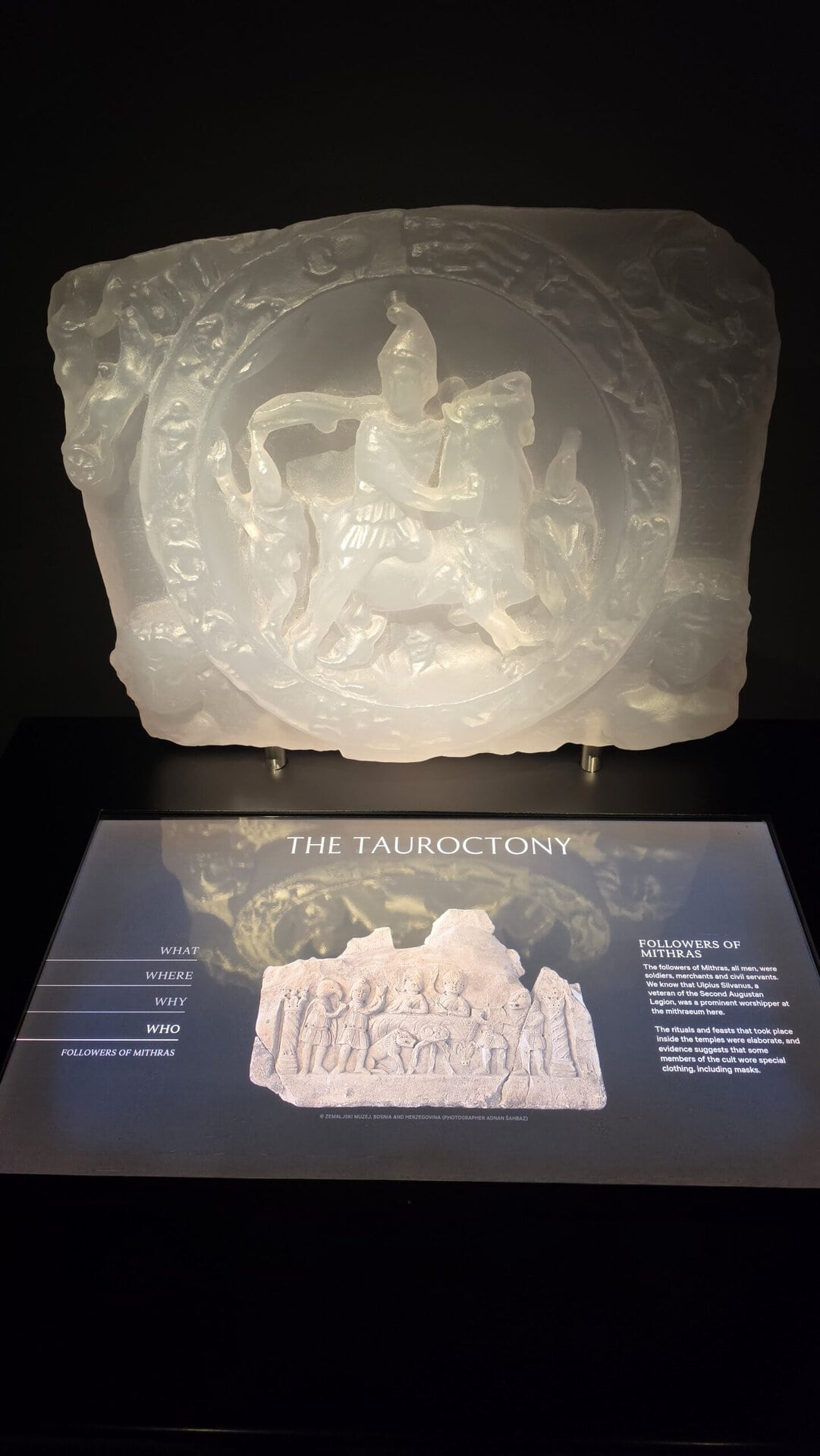
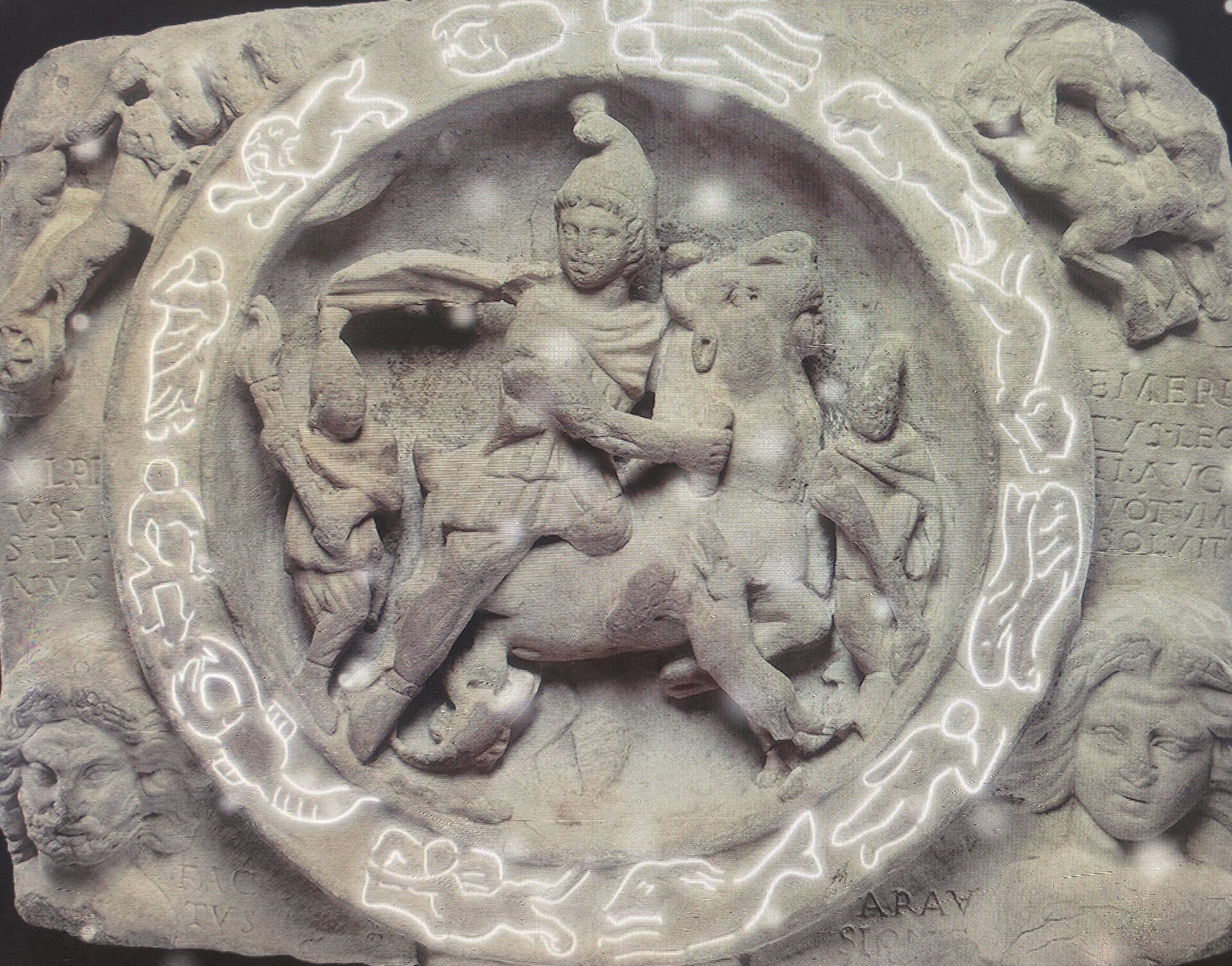
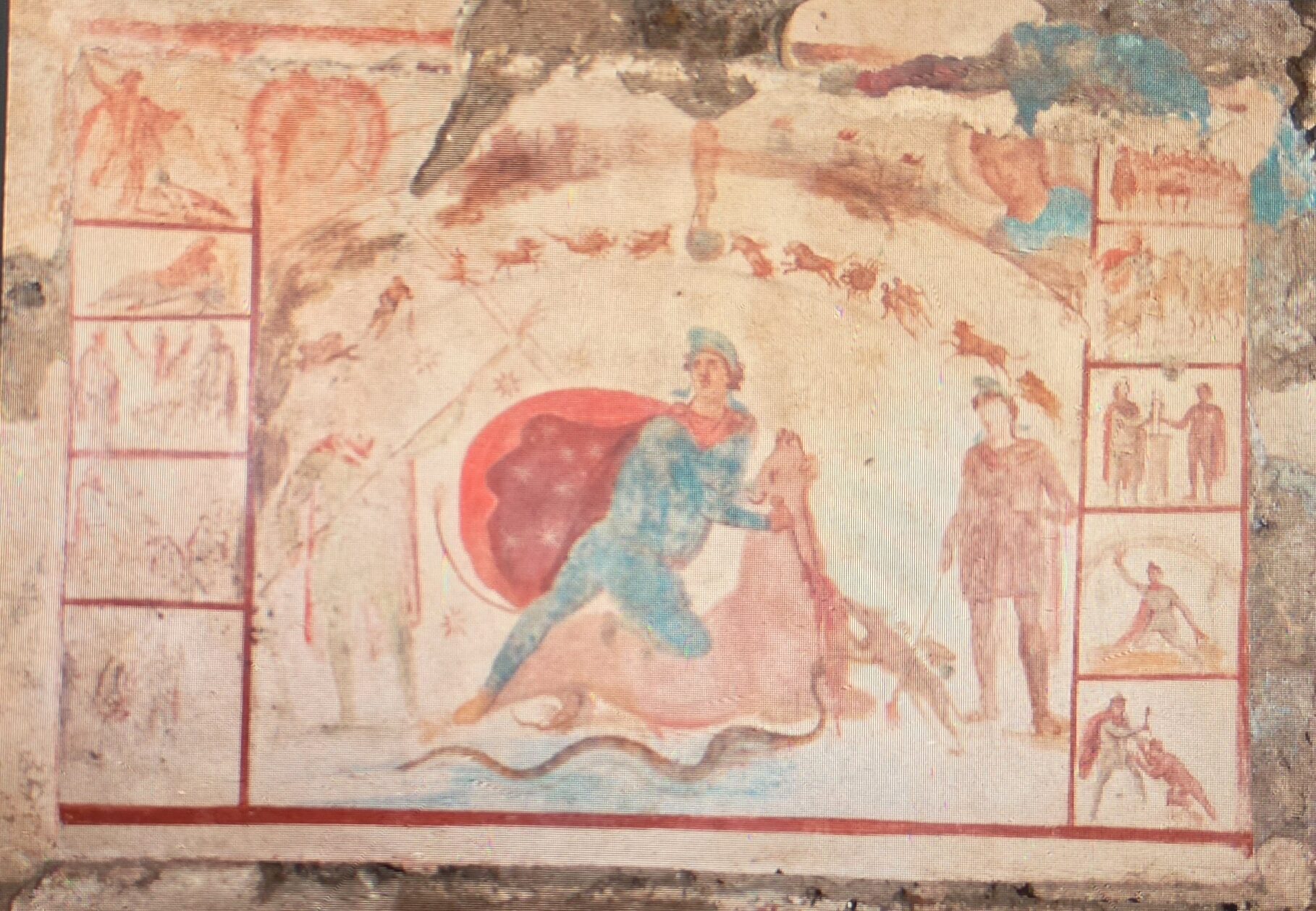
Few religious images from Roman antiquity are as immediately recognizable — or as difficult to explain — as the tauroctony.
Mithras kneels or leans across the back of a bull. He pulls the animal's head backwards and drives a blade into it.
But he is rarely alone.
A dog commonly reaches towards the wound. A snake approaches the bull. A scorpion attacks its genitals. A raven may appear above. Two torchbearers, Cautes and Cautopates, frequently stand on either side.
Above them, the celestial world can intrude into the scene. Sol, the Sun, and Luna, the Moon appear repeatedly in Mithraic imagery. In some examples, the zodiac itself surrounds the composition.
What exactly are we looking at? A sacrifice? An act of creation? A cosmic drama? A symbolic map of the heavens? Perhaps elements of several of these ideas?
One of the most fascinating aspects of Mithraism is its relationship with the heavens.
The Sun and Moon recur throughout Mithraic imagery. Zodiacal signs appear on certain monuments. Planetary associations have been connected with the seven grades of initiation.
Even some of the animals surrounding the tauroctony have been interpreted as celestial references.
This has produced one of the most intriguing questions in Mithraic studies: was the Mithraeum itself conceived as a model of the universe?
One influential interpretation, developed especially in modern scholarship by Roger Beck, considers the possibility that the sanctuary was not simply a room containing astronomical symbols. The entire space could have possessed cosmological meaning.
This idea has an important ancient precedent. The third-century philosopher Porphyry describes a cave dedicated to Mithras as an image of the cosmos.
If the cave represents the universe, entering the Mithraeum could have meant more than entering a secret temple. It could symbolically mean entering the cosmos itself.
It is tempting today to encounter the word “zodiac” and immediately think of astrology in its modern popular sense. That would be misleading.
For the ancient world, the zodiac could form part of a much broader understanding of the structure and movement of the heavens.
The repeated presence of Sun and Moon suggests that the story of Mithras was imagined on more than an earthly level.
The more useful concept is cosmology: the architecture of the universe and the possible place of the initiate within it.
The question is not whether Mithraic initiates were reading horoscopes in the modern sense. The more interesting question is whether the zodiac helped describe the universe through which Mithras — and perhaps symbolically the initiate — operated.

Mithraism was an initiatory religion.
Evidence preserves the names of seven grades: Corax — Raven; Nymphus — Bridegroom; Miles — Soldier; Leo — Lion; Perses — Persian; Heliodromus — Sun-Runner; and Pater — Father.
The existence of these grades is well established. Exactly how progression between them worked is much less certain.
Some evidence associates them with particular symbols, divine powers and planetary relationships. Modern reconstructions have therefore asked whether advancement through the grades could have represented a symbolic ascent.
Again, certainty is impossible. There is no surviving handbook explaining a Mithraic initiation from beginning to end.
The unanswered questions are not an inconvenience to be filled with fantasy. They are part of what makes Mithraism historically fascinating.
Rome is an extraordinary city in which to investigate Mithraism because its ancient religious landscape frequently survives beneath later Rome.
Mithraea were absorbed into an urban fabric that continued to change for centuries after the cult disappeared. Churches were built above ancient structures. Imperial complexes were reused. Streets changed level. Entire layers of the ancient city disappeared beneath medieval and modern buildings.
As a result, encountering Mithras in Rome often involves physically descending.
One of the most famous examples of Rome's layered archaeology, where a Mithraic sanctuary survives beneath later structures.
A remarkable sanctuary connected with the monumental heart of ancient Rome and now one of the most distinctive Mithraic contexts in the city.
A Mithraeum discovered within one of Rome's greatest imperial bathing complexes.
An exceptional concentration of Mithraea that reveals how deeply the cult became embedded within the communities of Rome's ancient port.
Taken individually, each sanctuary tells a local story. Seen together, they begin to form a network.
On 8 September 2026, our search for Mithras continued in London.
It is easy to understand Mithraism intellectually as a religion that spread across the Roman Empire. It is something different to descend beneath the modern City of London and stand inside the remains of a sanctuary belonging to that same religious world.
Above is one of the most intensely modern urban environments in Europe: glass, steel, offices, finance and commuters.
Below it is Londinium.
And within that buried Roman city survives the London Mithraeum.
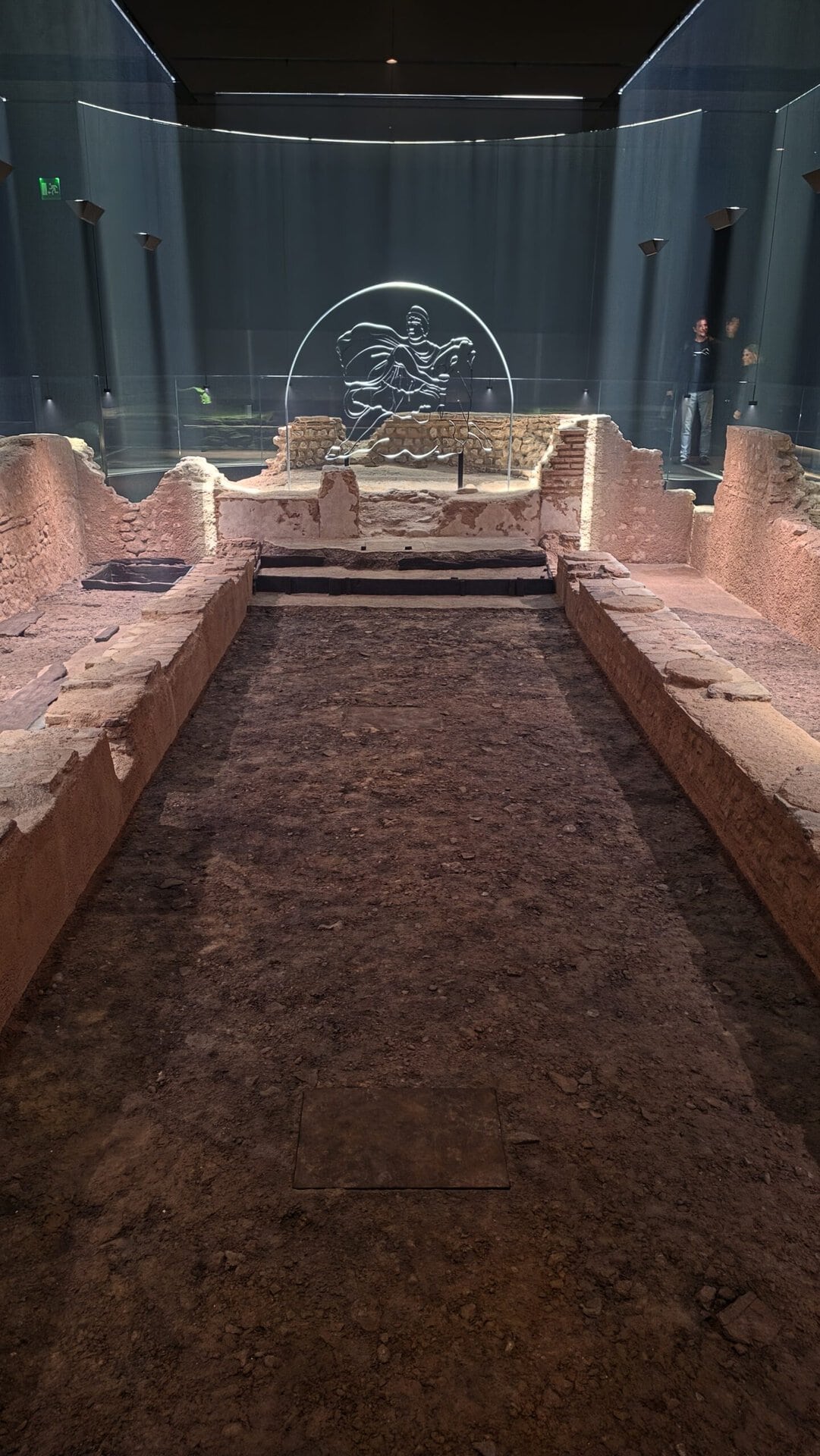
The temple stood close to the ancient River Walbrook and was established during the third century AD.
Its rediscovery in the twentieth century became one of Britain's most celebrated archaeological stories.
During excavations in 1954, archaeologists uncovered the remains of the Roman structure. Then came the discovery that transformed the interpretation of the site.
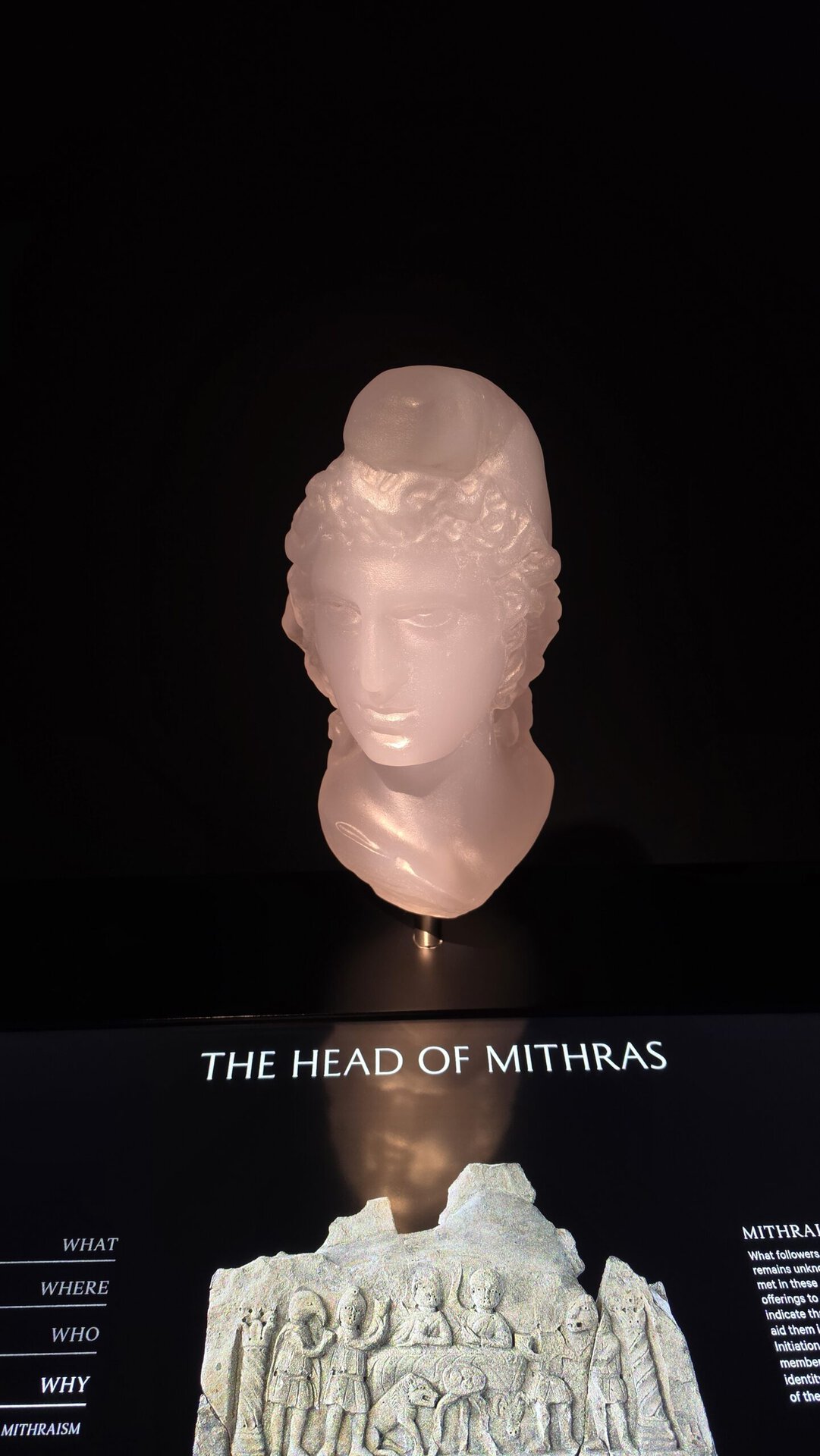
On 18 September 1954, a marble head of Mithras was found.
The identification of the sanctuary became clear.
The discovery generated enormous public interest. Thousands of people came to see the excavations, demonstrating something that remains true today: underground archaeology has an unusual ability to collapse the distance between a modern city and the people who inhabited the same ground almost two thousand years earlier.
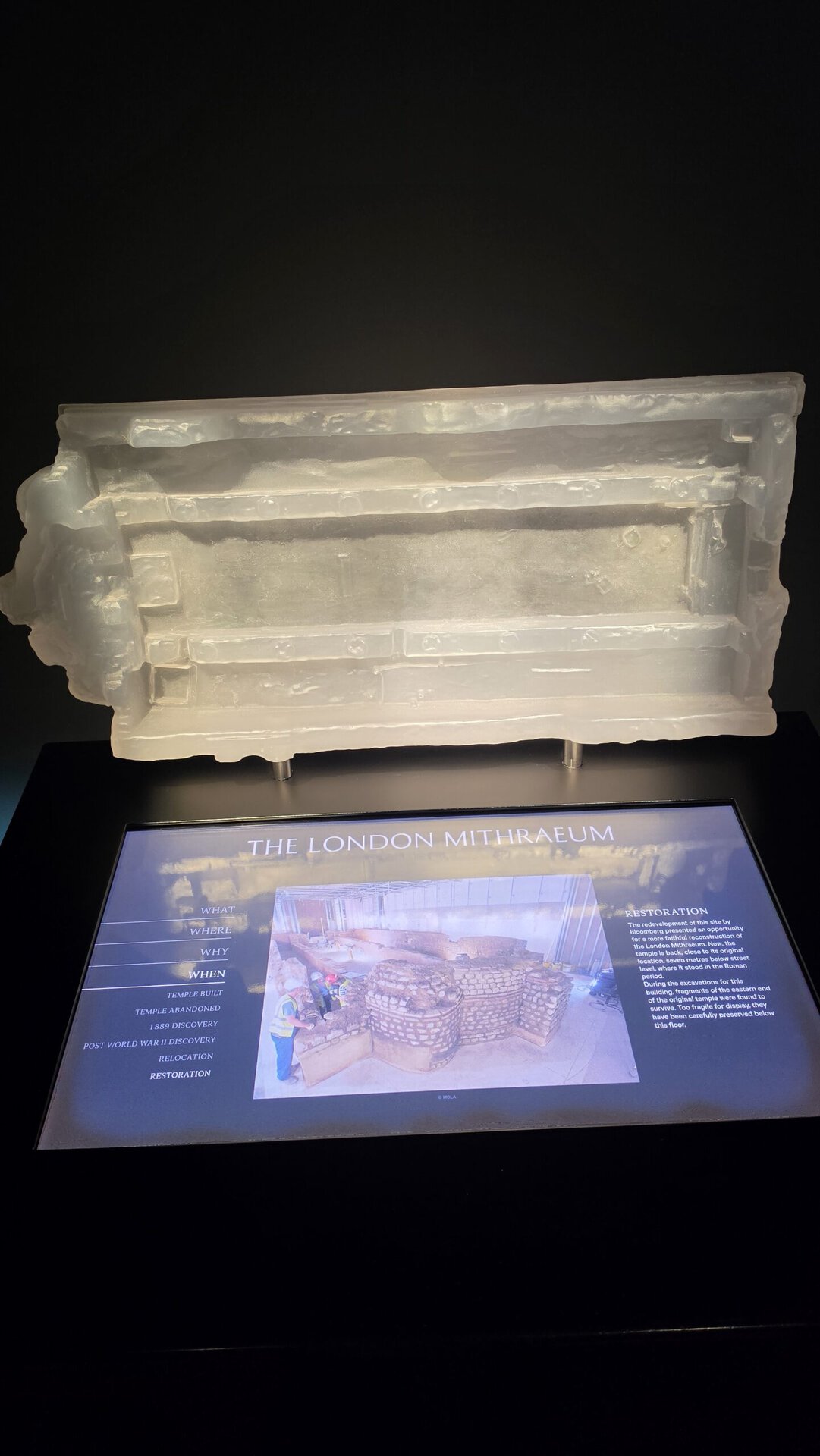
The temple was subsequently moved from its original position. Decades later, as part of the development of Bloomberg's European headquarters, the Mithraeum was reconstructed close to its original location and at approximately its Roman level.
Today, visitors descend beneath the modern City to encounter the reconstructed sanctuary.
What makes the London Mithraeum particularly effective is not simply the archaeological remains themselves.
It is the transition.
You begin in the City of London. Then you descend. The modern city gradually disappears and the Roman city takes its place.
For us, that physical movement immediately recalled one of the recurring characteristics of exploring Mithraism in Rome.
Mithras is frequently encountered through descent — not because every Mithraeum in antiquity was literally underground, but because the surviving archaeology of modern cities, combined with the cult's own cave-like architectural language, repeatedly produces this experience.
You leave the street. You enter a confined space. Light changes. Sound changes. The scale becomes intimate.
And suddenly the cosmic imagery of Mithraism becomes even more interesting.
Standing within a Mithraeum changes the way its symbolism can be considered.
Looking at a photograph of a tauroctony in a book encourages us to analyse individual elements: the bull, the scorpion, the dog, the snake, Sol, Luna and the zodiac.
But a Mithraeum was not a page in a book. It was an environment.
Initiates occupied the benches. Lamps illuminated the room. Ritual actions took place within a controlled space. The principal image dominated one end of the sanctuary.
If cosmological interpretations of Mithraism are correct — even partially — the architecture matters.
Perhaps the initiate did not simply look at an image of the cosmos.
London cannot prove that hypothesis. No individual Mithraeum can. But visiting these spaces makes clear why architecture must be considered alongside iconography.
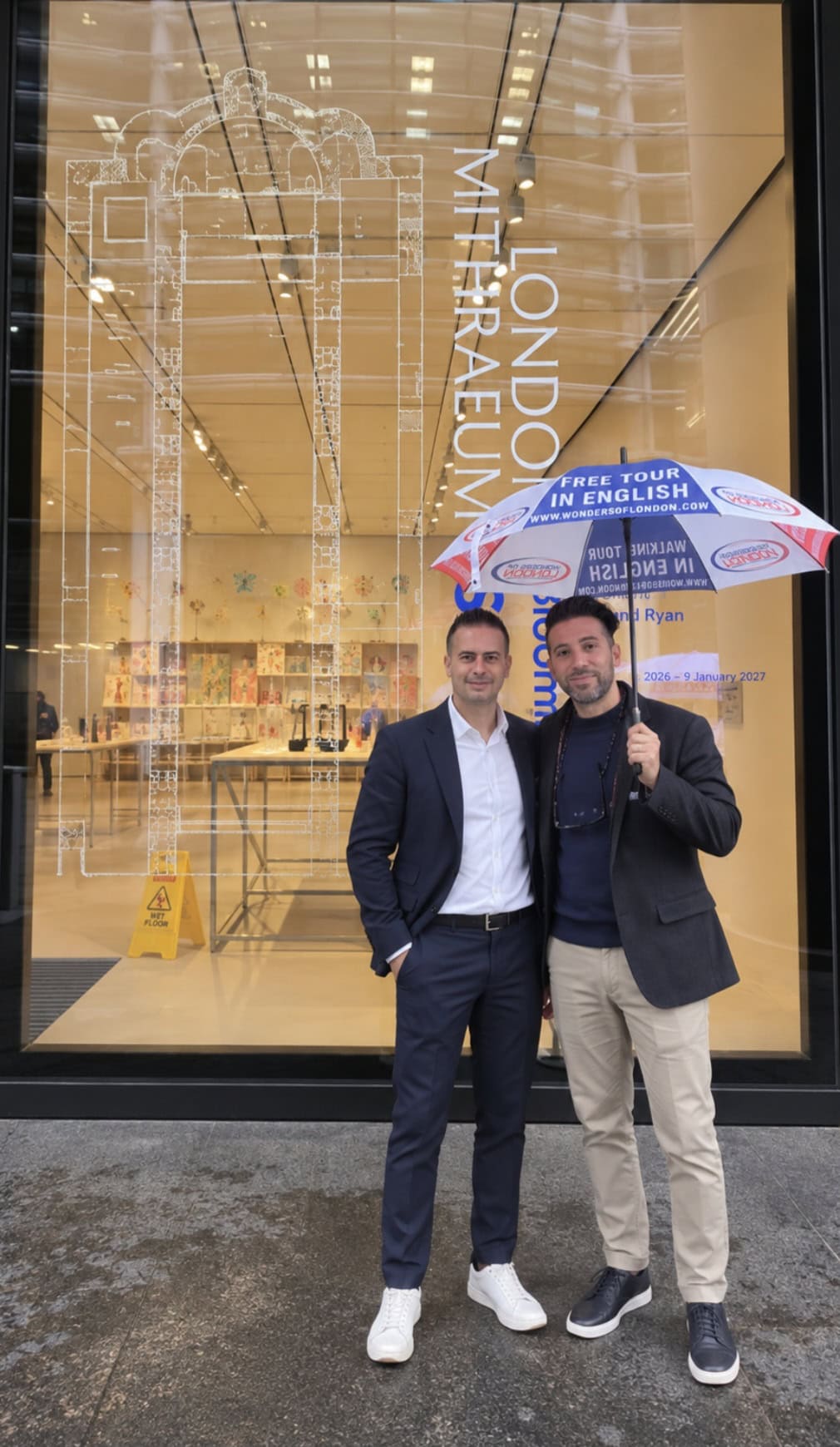
The London visit also gave the project a more human dimension.
We visited the Mithraeum together with Valerio from Wonders of London, exchanging perspectives on two cities that preserve very different layers of the same Roman world.
That is why the photograph above belongs here. It is not a partnership statement or a promotional insert. It simply records the moment when a project rooted in Rome physically followed Mithras to another Roman city.
Rome and London occupied very different positions within the Empire, yet beneath both modern cities survive traces of the same cult.
London will not be the end of that journey.


A sanctuary in Rome cannot simply be treated as interchangeable with one in London.
Each existed within a different urban, social and historical environment.
But repeated elements connect them: the long enclosed room, communal benches, the bull-killing Mithras, celestial imagery, the language of initiation and the sense of entering a space removed from ordinary public life.
The similarities reveal a religious network extending across enormous distances.
The differences remind us that this network was lived locally.
Mithraism flourished in a world characterized by movement.
Soldiers were transferred between provinces. Merchants travelled. Officials served far from their places of origin. Goods, languages, images and religious ideas moved through the same networks that connected the Roman Empire economically and militarily.
Mithraic communities appear particularly strongly in some military and commercial environments, although the cult should not be described simply as “the religion of Roman soldiers.” Its membership was more varied.
What matters is mobility.
A religious system built around relatively small communities could reproduce itself far from Rome without requiring enormous public temples.
The same symbols could be recognized thousands of kilometres away.
This is one reason Mithraism offers such an unusual way of understanding Rome: not only as a capital, but as the centre of a network through which people and ideas travelled.
Mithraism is frequently compared with early Christianity.
Some comparisons are legitimate areas of historical investigation. Both religious worlds developed inside the Roman Empire. Both involved communal identity and ritual. Both used powerful ideas involving salvation, light and divine mediation.
But popular accounts often go much further than the evidence allows.
Claims that Christianity simply copied Mithraism — or that Mithraism was essentially a pagan version of Christianity — flatten two complex religious traditions into a convenient modern story.
Chronology, evidence and context matter.
Mithraism should be studied on its own terms.
Mithraism disappeared as a living religion in Late Antiquity.
Its temples were abandoned, transformed, buried or destroyed. Its initiates stopped explaining their mysteries. Eventually there was nobody left who could tell us exactly what the tauroctony meant.
Paradoxically, this disappearance is part of the reason Mithras remains so compelling.
We are forced to approach the cult archaeologically.
A sculpture found during excavation matters. The position of a bench matters. An inscription matters. The relationship between a doorway and an altar matters. A zodiac carved around an image matters. The location of one Mithraeum relative to another matters.
The mystery cannot be solved by inventing what has been lost.
This page begins in Rome, but Mithras does not stop at the boundaries of the city.
London has already become part of the story. Other Mithraea across the former Roman world can follow as we encounter and document them.
With each new site, this page can grow: new photographs, new archaeological contexts, new comparisons, new questions and — when the evidence permits it — new connections.
Not as a finished article about a dead religion, but as an evolving journey through the surviving world of Mithras.
Rome is where we begin. The Roman world is where Mithras leads us.
Experience the Mithraeum of the Circus Maximus
Private arrangements are subject to access, date and availability.
