
Passetto di Borgo
Above the streets between the Vatican and Castel Sant'Angelo runs a fortified passage built for one purpose: to give the pope a way out when Rome became dangerous.
The Passetto di Borgo is one of those Roman monuments that makes sense only when you imagine the city in crisis.
Today the Borgo district is filled with pilgrims, visitors and restaurants.
For centuries, however, the same streets formed part of a defensive landscape surrounding the Vatican.
Above them, a protected corridor connected papal power with one of the strongest fortresses in Rome: Castel Sant'Angelo.
What Is the Passetto di Borgo?
The Passetto is an elevated fortified passage approximately 800 metres long linking the Vatican area with Castel Sant'Angelo.
Rather than forcing the pope to enter the streets during an emergency, the corridor provided a protected route towards the fortress.
Its walls, narrow passages and elevated position reveal an aspect of papal Rome that is easy to forget today: the pope was not only a religious leader.
For centuries, he was also a political ruler surrounded by rival families, foreign armies and the instability of medieval and Renaissance Italy.
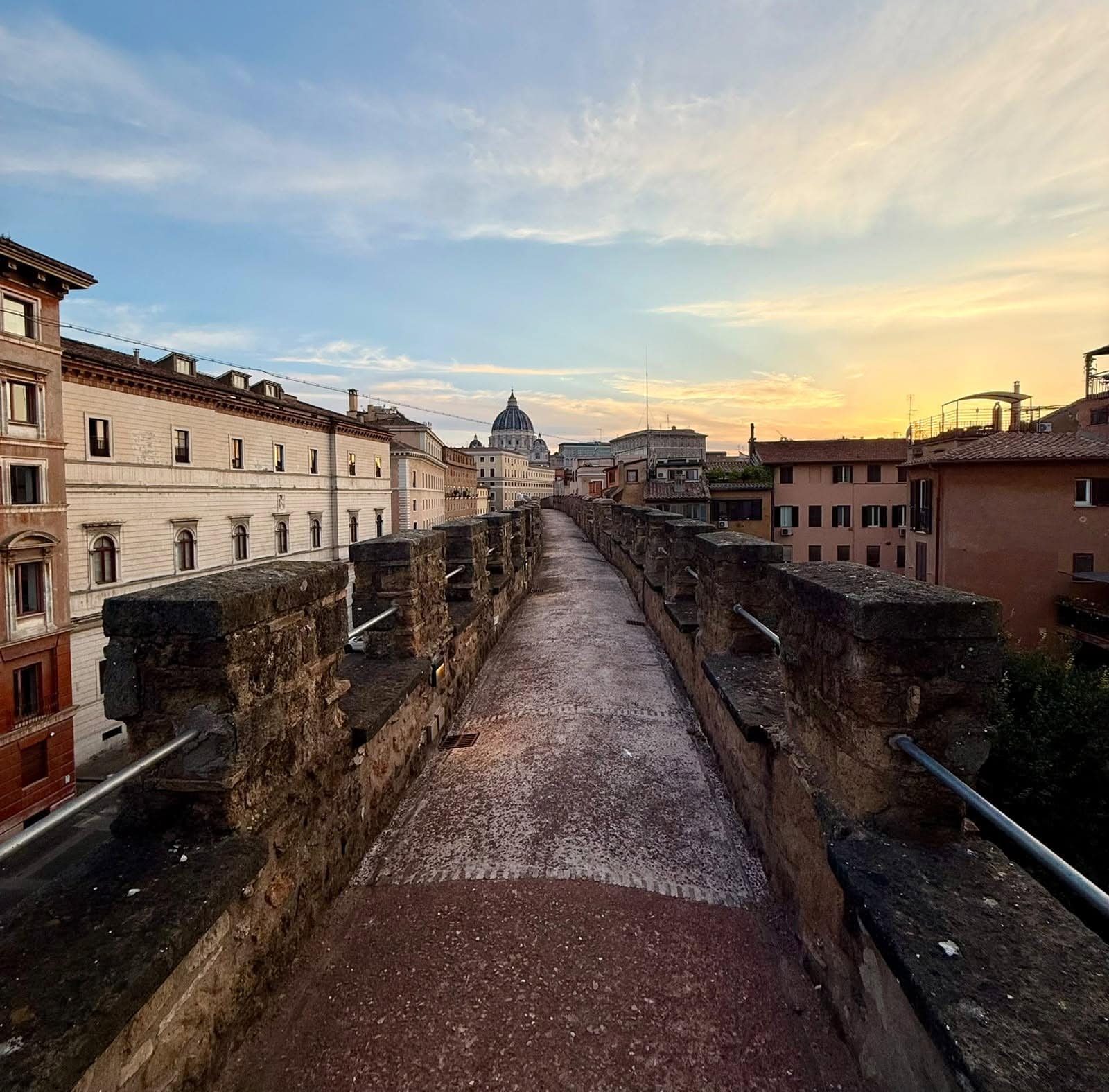
The Passetto di Borgo running above the streets between the Vatican and Castel Sant'Angelo.
The Passage Grew Out of the Defences of the Vatican
The history of the Passetto is closely connected with the Leonine Walls, constructed during the ninth century to protect the area around Saint Peter's.
Rome had recently suffered devastating attacks, and the Vatican required stronger defences.
Over subsequent centuries, the defensive system evolved and the connection towards Castel Sant'Angelo became increasingly important.
Why Did the Escape Route Lead to Castel Sant'Angelo?
Castel Sant'Angelo had begun its life as the Mausoleum of Emperor Hadrian.
By the Middle Ages, its enormous masonry, strategic position and defensive potential had transformed it into one of Rome's most formidable fortresses.
Linking the Vatican directly to the castle therefore created a logical emergency system.
If the Vatican could no longer be defended, the pope could attempt to reach the stronger refuge beside the Tiber.
Explore the fortress through our Castel Sant'Angelo Private Tour .
The Day the Passetto Became a Lifeline
The most famous episode in the history of the passage came during the Sack of Rome in 1527.
Imperial troops entered the city during one of the most catastrophic events of Renaissance Rome.
Churches, palaces, monasteries and private houses were looted as violence spread through the city.
The Vatican itself was threatened.
A Last Defence at Saint Peter's
As the attacking forces reached the Vatican area, members of the Swiss Guard fought to protect Pope Clement VII.
The defence became one of the most famous episodes in the history of the corps.
Many guards were killed, but the resistance helped create the time required for the pope to escape.
A passage built into a medieval wall suddenly became the difference between capture and survival.
The Pope's Escape Through the Passetto
Clement VII left the threatened Vatican and entered the protected corridor towards Castel Sant'Angelo.
The route allowed him to move above the streets while violence continued below.
At the end of the corridor stood the fortress.
The episode transformed an architectural security measure into one of the most dramatic escape routes in European history.
Escape Did Not Mean Safety
Reaching Castel Sant'Angelo saved Clement VII from immediate capture.
But the pope then found himself effectively trapped inside the fortress while Rome suffered below.
The ancient Mausoleum of Hadrian had become the final defensive refuge of Renaissance papal power.
Few monuments illustrate Rome's capacity for transformation more clearly: imperial tomb, medieval fortress, papal residence and emergency sanctuary.
The Passetto Connects Three Different Romes
Hadrian's Mausoleum
The corridor ultimately leads to a Roman imperial tomb transformed into a fortress.
Defensive Walls
The Passetto grew within the fortified landscape created to defend the Vatican.
Papal Survival
In 1527, the corridor proved its value during one of Rome's greatest political disasters.
The Vatican and Castel Sant'Angelo Were Once Part of the Same Defensive World
Modern visitors often experience Saint Peter's Basilica and Castel Sant'Angelo as separate attractions.
Historically, their relationship was much closer.
The Passetto physically connected the spiritual centre of papal authority with the fortress capable of protecting the pope during emergencies.
Religion, politics and military defence were therefore literally joined by architecture.
Can You Walk the Passetto di Borgo?
Yes.
Following restoration and conservation work, the Passetto di Borgo reopened to public visits.
Access is organised through guided visits connected with the Museo Nazionale di Castel Sant'Angelo.
The visiting programme is controlled by the institution and can change according to conservation needs, events and operational requirements.
Official guided visits are currently available on selected days through the Italian Ministry of Culture's Musei Italiani booking system.
Because schedules and access conditions can change, guests interested in including the Passetto in a private programme should verify availability for their specific travel dates.
Following the Escape Route With Context
Walking the Passetto is only part of the experience.
The real story becomes clear when the corridor is connected with Saint Peter's, the Sack of Rome, Clement VII, the Swiss Guard and Castel Sant'Angelo.
Depending on official availability, a private itinerary can be designed around the Passetto and combined with Castel Sant'Angelo , the Vatican area and the wider history of papal Rome.
Millions Walk Beneath It Without Knowing Its Story
The Passetto is not hidden underground.
Much of it is clearly visible above the streets of Borgo.
What is hidden is its meaning.
Without the history, it can appear to be simply another old wall.
Once its purpose is understood, the same structure becomes a surviving piece of papal security architecture.
Follow the Route That Once Saved a Pope.
We design private itineraries connecting the Passetto di Borgo, Castel Sant'Angelo and the hidden political history of Vatican Rome, subject to official access availability.
Request a Private Experience